Waterloo Chiropractor, Waterloo Physiotherapist, and Massage Therapist (RMT)

Category

Sports Science

By Dr. Sean Delanghe BSc. (Hons), DC

Hi, I write a lot of articles about health, injuries, exercise and pain. But there is an important question behind everything I write:

How do we actually know that this is good advice?

We live in an interesting time. The internet has given almost everyone access to an enormous amount of health information. Google can find you an article, TikTok can give you a 30-second explanation, and someone with 100,000 Instagram followers can confidently tell you that their favourite treatment is “backed by science.”

But there is a big difference between having an opinion about health and having good evidence to support that opinion.

When I write an article, I am generally not starting with, “Here is what I think.” I’m one person who is, despite my best efforts, full if biases!

Instead, I start by asking:

What does the research actually show?

And not all research is created equal.

There is a general hierarchy of evidence that researchers and clinicians use to help determine how much confidence we should place in different types of information.

If you don’t want to read more, long story short, the vast majority of my articles are based on systemtic reviews and meta-anlaysis- the absoutely highest form of medical evidence.

But what exactly does that mean? Here’s a summary in order ot highest worst to best.

1. Professional or Expert Opinion

“I have treated thousands of patients and this is what I see.”

This is often where health information starts.

A doctor, physiotherapist, chiropractor, researcher or other professional may have decades of experience and develop a strong clinical opinion about what works.

Experience is valuable. Clinicians learn a tremendous amount from seeing real patients.

The problem is that experience can be misleading.

If 100 patients receive a treatment and 80 improve, it might seem obvious that the treatment worked. But what if many would have improved anyway? What if they were also exercising, sleeping better or simply recovering naturally?

Without a comparison group, it can be difficult to know what actually caused the improvement.

Bottom line: Expert opinion can be useful, particularly when research is limited, but it is relatively vulnerable to personal bias and other explanations.

2. Case Reports and Case Series

“We treated this person, and this happened.”

A case report describes an individual patient. A case series describes a group of patients with something in common.

These can be useful for identifying unusual conditions, unexpected side effects or interesting new observations.

For example, if a doctor sees an unusual reaction to a medication that has never been reported before, documenting it can alert other researchers to a possible problem.

But there is an obvious limitation:

There is usually no comparison group.

We don’t know what would have happened if the patient had received a different treatment—or no treatment at all.

Bottom line: Useful for generating questions and identifying unusual findings, but generally weak evidence for proving that a treatment works.

3. Case-Control Studies

“Let’s compare people who have the problem with people who don’t.”

Researchers can take a group of people who have a particular condition and compare them with people who don’t.

They then look backwards to see whether the two groups were exposed to different risk factors.

For example, researchers might compare people with a particular type of back pain with people without it and ask whether their previous activity levels, occupations or other factors were different.

This can be particularly useful for studying relatively uncommon conditions.

The limitation is that researchers are looking backwards, which can introduce problems such as recall bias and other confounding factors.

Bottom line: Useful for identifying associations and potential risk factors, but generally cannot prove that one factor caused another.

4. Cohort Studies

“Let’s follow people and see what happens.”

A cohort study follows a group of people over time.

For example, researchers could follow thousands of runners for five years and record how much they run, their training habits and whether they develop injuries.

This can provide useful information about relationships between exposures and outcomes.

However, it is still an observational study.

People aren’t randomly assigned to different behaviours. A runner who trains 100 km per week may also sleep differently, eat differently, have different genetics and participate in different sports than someone running 20 km per week.

So if the 100 km runner develops more injuries, we can’t automatically say that mileage caused them.

Bottom line: Very useful for studying risk factors, prognosis and long-term outcomes, but associations don’t necessarily prove causation.

5. Randomized Controlled Trials

“Let’s actually test the treatment.”

This is where things get particularly interesting.

In a randomized controlled trial (RCT), participants are randomly assigned to different groups.

For example:

  • Group A receives Treatment X
  • Group B receives Treatment Y or a control
  • Researchers compare the outcomes

Because participants are randomly allocated, the groups should be relatively similar at the beginning of the study.

That helps reduce the influence of other factors that could affect the outcome.

This is one of the main reasons randomized trials are generally considered strong evidence for determining whether a treatment actually causes an improvement.

But RCTs aren’t perfect. They can be expensive, take years to complete and sometimes involve highly selected patients who don’t perfectly represent people in everyday practice.

Bottom line: For questions such as “Does this treatment work?”, a well-designed randomized controlled trial provides some of the strongest individual pieces of evidence available.

6. Systematic Reviews

“Let’s find all the good studies and look at them together.”

Now we get to one of the most useful levels of evidence.

A systematic review doesn’t usually conduct a new experiment. Instead, researchers systematically search for all of the relevant studies addressing a specific question.

They then assess the quality of those studies and summarize what they found.

Imagine you have 15 randomized trials looking at whether a particular exercise program helps people with knee pain.

One study says it works. Another says it doesn’t. Several show a small benefit.

Instead of choosing whichever study supports your preferred opinion, a systematic review looks at the entire body of relevant evidence.

This matters because individual studies can produce misleading results through chance, differences in methodology or other limitations.

Bottom line: For many treatment questions, a well-conducted systematic review of randomized controlled trials is considered one of the strongest forms of evidence available.

7. Meta-Analysis

You will often hear the term meta-analysis alongside systematic review.

They aren’t exactly the same thing.

A systematic review is the process of finding, assessing and summarizing relevant research.

A meta-analysis is a statistical method that can sometimes be used within a systematic review to combine the numerical results of multiple studies.

In simple terms, instead of saying:

Study 1 found a small benefit.
Study 2 found a moderate benefit.
Study 3 found little benefit.

Researchers can statistically combine the results to estimate the overall effect.

This can give us a more precise estimate of what the research collectively suggests.

But- putting bad studies together doesn’t magically create good evidence.

A systematic review can still be limited if the studies it contains are poorly designed, inconsistent or answering slightly different questions.

Bottom line: Meta-analysis can strengthen our understanding of an overall effect, but the quality of the underlying studies still matters.

So What’s the Hierarchy?

For a straightforward treatment question, you can think about the evidence roughly like this:

Lower confidence

Expert opinion

Case reports / case series

Case-control studies

Cohort studies

Randomized controlled trials

Systematic reviews / meta-analyses of randomized trials

Practicel Applications

Knowing this hierchay is a massive step in the right direction, but not the full picture. This is not a simple “higher is always better” pyramid.

Different types of studies are better suited to answering different questions. A randomized trial might tell us whether a treatment works. A cohort study might tell us what happens to people over 10 years. A case report might be the first clue that a very unusual side effect exists.

When I write about a health topic, I try to work my way up this evidence ladder. I try to find the best available research, with particular attention to systematic reviews and randomized controlled trials when they are appropriate for the question.

Then I look at the quality of that research, whether the results are consistent, how large the effect actually is, and whether the findings apply to the average person sitting in front of me.

As always, if you have any questions, free free to reach out or book online HERE.
By: Dr. Sean Delaghe BSc (Hons) DC

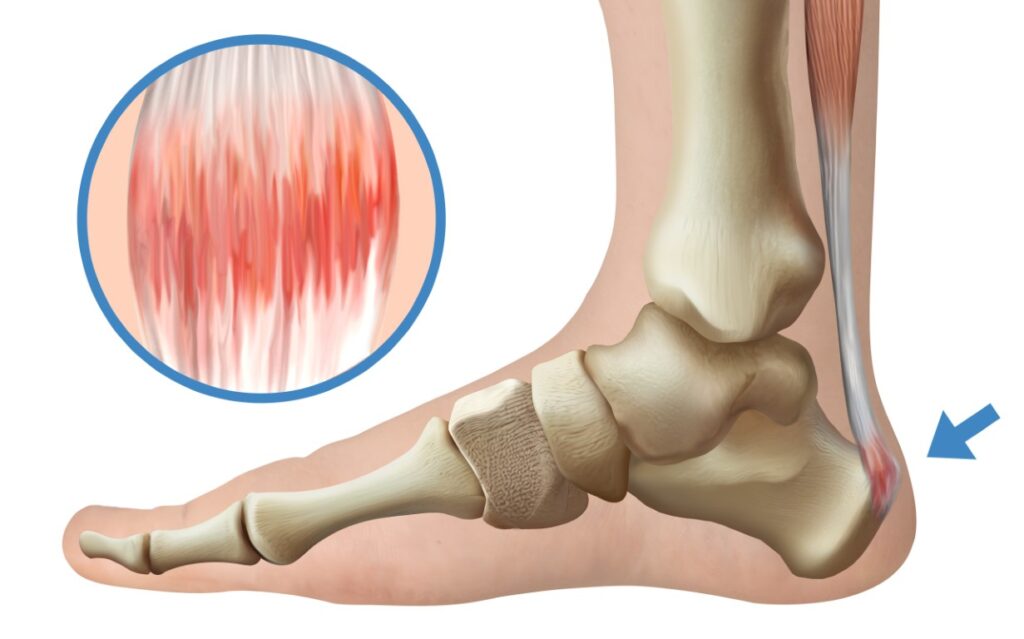
Tendons are strong connective tissues that connect muscles to bones and are primarily made up of highly organized collagen fibres. When a tendon becomes painful or develops structural changes, terms such as tendinitis, tendinosis, and tendinopathy are often used interchangeably. However, these terms imply different underlying processes.

This might be a boring srticle for some, but underdtanding what’s going on at the microcopic level in your tendon will help you decide and unerstand how you should treat it and progres through rehab!

Historically, tendon pain has often been described as “tendinitis,” suggesting that inflammation is the primary cause of the problem. However, research examining painful tendons under a microscope has increasingly questioned this idea. Instead, chronic tendon problems often demonstrate changes in the organization and composition of the tendon itself, with relatively little evidence of traditional inflammatory cells.

The purpose of this systematic review was to examine the histological characteristics of abnormal tendon and connective tissue and determine whether degeneration, inflammation, or other structural changes were consistently present. 

Results

This study was a systematic review, meaning the researchers collected and analyzed findings from many previous studies.

Included Studies

  • 3,196 studies were initially identified.
  • 52 studies ultimately met the inclusion criteria.
  • The studies examined human tissue samples from a variety of tendon and connective-tissue conditions.
  • The researchers specifically looked for features such as:
    • Mucoid degeneration(buildup of a gel-like substance within the tendon, making the tissue less organized and mechanically weaker)
    • Collagen disorganization(loss of the normal, parallel arrangement of collagen fibres that gives tendons their strength)
    • Increased extracellular matrix(more of the non-cellular material surrounding tendon cells, including proteins and other substances)
    • Inflammation(an immune response involving inflammatory cells and chemical signals that can occur when tissue is irritated or injured)
    • Increased blood vessels / vascularity(growth or increased presence of small blood vessels within the tendon tissue)

What Did Abnormal Tendons Look Like?

The most consistent finding was structural degeneration of the tendon tissue.

Results:

  • 100% of studies identified at least one feature of mucoid degeneration.
  • 71% reported disorganized collagen.
  • 69% reported increased extracellular matrix.
  • 33% reported chondroid metaplasia, where tendon cells develop some characteristics that resemble cartilage cells.

In simple terms, abnormal tendons frequently lose some of their normal, highly organized collagen structure and develop changes in the surrounding tissue. 

What About Inflammation?

Interestingly, inflammation was much less consistently identified.

  • Only approximately 20% of studies specifically looking for inflammation reported inflammatory findings.
  • The majority of studies did not find significant classic inflammatory-cell infiltration.
  • This suggests that chronic tendinopathy is not simply an inflammatory process.

This is one of the reasons the term “tendinopathy” is often preferred over “tendinitis.” The word tendinitis implies that inflammation is the primary problem, while the histological evidence suggests that structural changes are much more consistently present. 

What About Increased Blood Flow?

Increased vascularity, or the presence of additional blood vessels, was also commonly reported.

  • Approximately 83% of studies reported increased vascularity.
  • However, the authors noted that many studies assessed this subjectively rather than using precise measurements.

Therefore, there is evidence that blood-vessel changes are common, but the evidence is not as strong or consistent as the evidence for collagen and extracellular-matrix changes.

Practical Applications

The findings of this systematic review suggest that chronic tendinopathy is better described as a condition involving changes in tendon structure and biology rather than simply inflammation.

This does not mean that inflammation never occurs in tendinopathy. Inflammatory cells and inflammatory signaling may play a role in some tendons and at certain stages of the condition. However, classic inflammation does not appear to be the dominant or defining feature of most chronic tendinopathy.

This distinction is important because seeing an abnormal tendon on an ultrasound or MRI does not necessarily mean that the tendon is acutely injured or that it needs to be protected from activity.

Instead, tendon structure can change over time in response to factors such as:

  • Aging
  • Mechanical loading
  • Training
  • Previous injury
  • Tissue adaptation
  • Individual biological factors

Therefore, tendon structure and tendon pain are not necessarily the same thing!

These chronic changes that are common (mucoid degeneration, digorganization of collagen) also don’t heal with rest- you’re only hope is to progressively load the tendons and give the body the opporunity the gradually adapt to that load overtime!

If you have any questions about your tendon pain, feel free to reach out to any of our Waterloo based chiropractors, physiotherpists or RMTs HERE.

By: SAYAKA TIESSEN, HONS. BKIN, MSCPT

Book here

Ankle sprains, AKA rolled ankles, have got to be one of the most common injuries out there. They can happen in the most innocuous situations, like stepping on an uneven surface, or during sports that require cutting and landing. The words “walk it off” are synonymous with ankle sprains. Get up. It’s nothing serious. Back to business.

I get the sense that most people that sustain an ankle sprain do not seek any guidance from a physiotherapist. It might swell up nicely for a day or two, but then you limp around and manage to get on with your life. What you might not appreciate though, is that ankle sprains have a high recurrence rate due to the residual effects of the initial injury. Things like ligament laxity and damage to the neural and musculotendinous tissue around the ankle can inhibit complete recovery. This can present as weakness, poor balance, and slower muscle response to load. You might not notice these deficits when you are walking around, but they do make you susceptible to re-injuring the area. This is why I always advocate for getting any old rolled ankle assessed by a physiotherapist.

I often prescribe a blend of resistance and balance training for my ankle sprain patients. But if you are super crunched for time, is there one that is more efficient than the other?According to a 2021 study, although resistance training and balance training on their own improves strength, hopping (explosiveness and control), and dynamic balance, if you had to pick one, balance training takes the edge. This is likely due to the high training load used in the study (20-30 second holds, 10-20x, 3-5 sets over multiple exercises), and the fact that you need to be strong and coordinated to balance well, and strictly strengthening will not challenge your proprioception (balance-ability). Time to get your Karate Kid on.

Want to know what kind of exercises are appropriate for you? Or have you sprained your ankle before and feel things are not quite right? You can book an appointment with me here!

We’re back again for the latest in my series on strength training for endurance athletes!

I’ve written previously about how and when strength training should be used in a nuanced way- it’s not as simple as ‘strength is always good!’ Check it out: hereherehere and here.

Now, the next question: is there a downside to strength training? Time costs aside, are there risks or detrimental aspects to including strength training in your quest to be a better endurance athlete? That is what I am taking a quick look at in this article.

Muscle hypertrophy:

First and foremost, based on my previous articles, we know the goal of strength training is to improve our running economy without losing any other components of why we run well. However, it’s not as simple as ‘build power, go faster;’ it’s about how you maximize your power-to-weight ratio.

The other consideration is that if you put on muscle mass, the ratio of the density of blood vessels carrying oxygen to the muscles vs. the volume of muscles they supply goes down – once again, hurting endurance performance.

The key with this is that higher rep, lower weight exercises don’t seem to give the same boost in performance that high weight, low rep strength work does. The flip side to this is that low rep exercises are what builds mass – something we don’t necessarily need to be faster. So, what’s the balance?

CLICK HERE to read the rest in the Run Waterloo Magazine.

Welcome back to my series on strength training and endurance sports. My last article looked at strength work and cycling economy- which was way back in June. I have a good excuse though: the birth of my daughter, Adeline Delanghe!

I would like to say “now that her sleep is normalizing blah blah,” but that simply is not the case. Instead, I’m just getting better at squeezing stuff in, which hopefully will result in more science of training articles for you all!

In any case, if you haven’t already, please review the first three articles in this series. The idea is not to give you a cookie-cutter, magical answer on how endurance athletes should utilize strength training. Instead, this is meant to introduce you to some of the nuances in the science, and how to decide if, when, and how much resistance training you should do.

Strength training 101: Impact on V02Max
Strength training 102: Impact on Running economy
Strength training 103: The impact of cycling economy

To add to the above, today’s article will take a look at another parameter of endurance performance- lactate threshold.

Strength Training and your Lactate Threshold (LT)

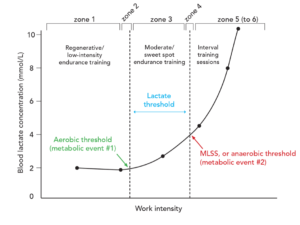
What is your LT? This is essentially the exercise intensity at which lactate accumulates in the blood faster than it can be removed. This is the “breaking point” so to speak between low and high-intensity work.

While V02max is important, having a high lactate threshold is crucial in endurance performance. The higher the lactate threshold is as a % of your V02max, the harder the effort you will be able to sustain for long periods of time. We don’t race at our V02max, but we do spend lots of time in and around our lactate threshold!

While V02max is a popular thing to measure and be proud of, as we have noted before, somebody with the highest V02max doesn’t always win the race, especially in running. As we discussed, this is in large part due to exercise economy. However, this is also seen when somebody has more effectively trained their lactate threshold despite not having the same max oxygen-consuming ability. In other words, having a slightly lower V02max that’s good enough, and a very highly trained LT can allow you to beat a competitor with a higher V02max.

V02max is the ceiling, and we want to max it out, and then get our LT as close to it as possible to be at our best!

CLICK HERE to read the rest on the Run Waterloo Blog.

The quest to give a more complete view of strength training and endurance sports continues!

In my first two articles in this series, I discussed the impact of strength training on your ability to consume oxygen (no major impact) and the impact on running economy.

In the article on strength training and running economy, I explained how 8-12 weeks of 2-3 sessions/week is required to see any change.  Heavy weight, low rep exercises seem to trump plyometrics and high rep exercises.   On top of this, masters and female runners are more likely to be responders.  I also discussed how simply running more, if you are a low volume runner, should be the first step in trying to get faster (of course there are other benefits to strength training if you are thinking beyond speed). 

Now, since there are so many multisport athletes who read this column, I thought I would address how strength training impacts cycling economy specifically.   Surprisingly, the relationship isn’t quite as clear!

Intuitively, you’d think it would almost be the opposite in the minds of most- that strength training would be more helpful to cycling than to running.  It kind of makes sense to speculate that cycling requires more powerful, larger muscles to smash big gears, while running requires light legs and next-level cardio.  Therefore, lifting weights should help cyclists more, right?  Wrong!

When we look at studies like THIS ONE, we see that cycling economy isn’t something that’s nearly as difficult to develop as running economy.  As studies like this one show, runners with no cycling training tend to have pretty good cycling economy, while cyclists have horrible running economy.  Cycling economy isn’t hard to train, but running economy is!

That’s also why we see that V02max is a great predictor of longer cycling event performance, while V02max does not do a great job of predicting running performance.  

So when we look at the studies on strength work and cycling economy, we get mixed answers. 

Click HERE to read the rest on the Run Waterloo magazine.

Welcome back to my series on strength training for endurance athletes.  Last article took a look at the role (or lack there of) of strength training and our ability to consume oxygen.    

That being said, we still know that strength training does have a positive impact on performance in endurance athletes.  The caveat: it has to be the right type of athlete, with the right type of deficiency conducting it at the right time in training.

So how do we decide how and when to implement strength training?  Learning the science of how it impacts us helps to guide these decisions in the best possible way.  This series most definitely is not a clear-cut, quick-fix answer, nor is it remotely all inclusive.  The more you learn, the more you will realize there is to learn!  Heck, I went to school for 8 years after high school in human-physiology related fields followed by 10 years in working and coaching in the field- and I definitely still feel like the more I learn, the more confusing it can become at times!  

That being said, the more information you arm yourself with, the more you will be able to start to tell the difference between pseudoscientific advice and real, efficient and effective performance-boosting advice.  Our next step toward this direction: How it impacts our exercise economy…  

CLICK HERE to read the rest on the Run Waterloo blog.

By: Sayaka Tiessen, Hons. BKin, MSc (PT)

It’s been a while! Life has been insanely busy the past couple months. You might have noticed on my social media feeds that I have moved my physiotherapy practice to join forces with Delanghe Chiropractic & Health/Health & Performance. Pumped for what this opportunity will bring!

So what’s on the agenda today? In honour of a few patients I have seen recently for a variety of running related injuries, we will be addressing the question: do injured runners run differently?

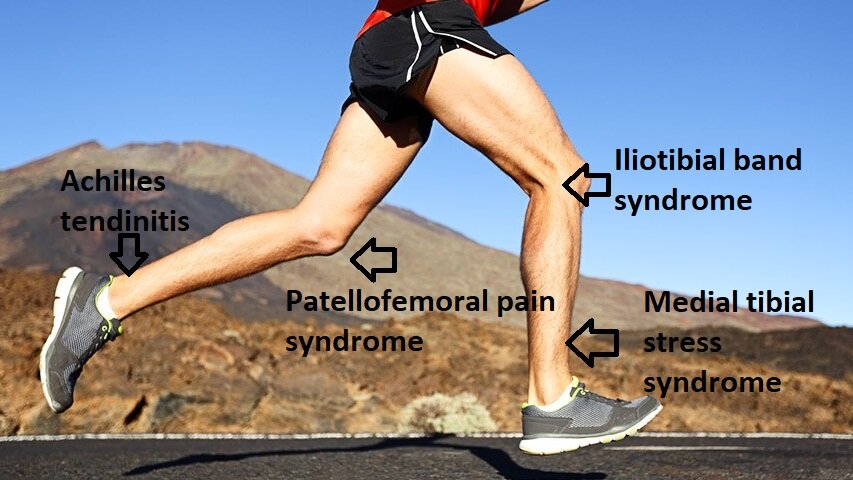
I will be drawing from an article by Christopher Bramah published in 2018 that looks at this very issue. He compared healthy runners (no reported injury in over 18 months) to injured runners to see if there were any run gait characteristics that were predictive of current injury. He specifically looked at the four most commonly cited soft tissue injuries in the running population: Patellofemoral Pain Syndrome, Iliotibial Band Syndrome, Medial Tibial Stress Syndrome, Achilles Tendinitis.

(Let’s just acknowledge the fact that I haven’t used Microsoft Paint in possibly a decade. How is it still a thing?)

You might not have heard of these conditions before, but you have probably experienced them. Here is a quick breakdown of what each of these injuries involve in the simplest of terms:

Patellofemoral Pain Syndrome (PFPS): pain around the patella, aka the knee cap at the front of the knee

Iliotibial Band Syndrome (ITBS): pain at the outside of the knee

Medial Tibial Stress Syndrome (MTSS): AKA Shin Splints (the bane of my existence for many years), pain around the inner part of the bottom 1/3 of the shin.

Achilles Tendinitis (AT): pain at the Achilles tendon.

I have to say, it’s always pretty neat when the findings of a study are similar to what you experience clinically. After analyzing the running biomechanics of the injured and non-injured study participants, Bramah’s team found that the injured runners presented with:

overstride.jpg
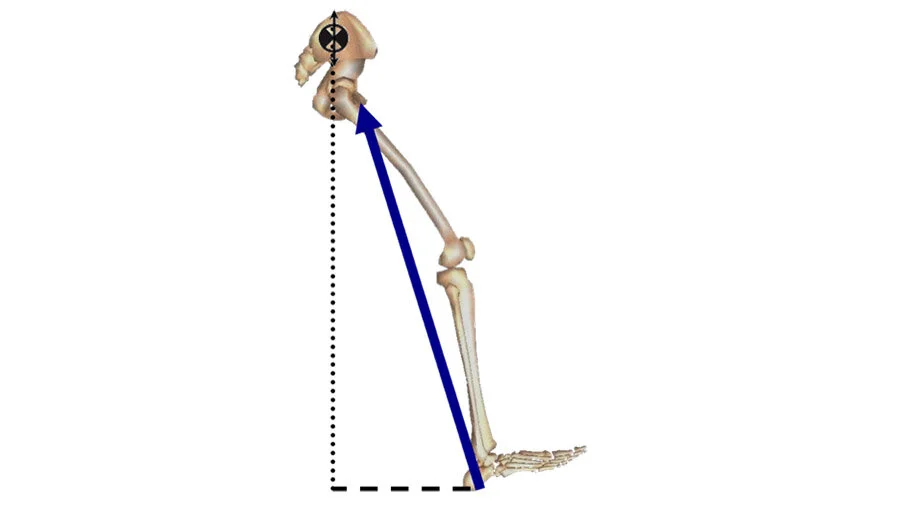
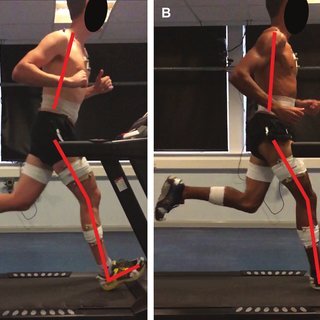
A straighter knee and ankle dorsiflexion (toes pulled up to the shin) when landing. This is essentially what we would call overstriding/overreaching while running – your foot is way out in front of your center of mass when you first hit the ground.
forward lean.jpg
Increased forward trunk lean. This can be caused by low back and gluteus maximus weakness/fatigue. We need to strike a balance of leaning forward too much and sitting back like you’re in a La-Z-Boy. Photo is from the Bramah et al. 2018 article.
trendelenburg.jpg
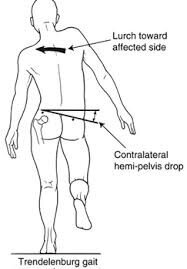
A significant drop in the opposite hip to the one they are standing on, also known as a Trendelenburg. This can be a sign of weakness of the hip stabilizing muscles on the leg they are standing on because they cannot keep the pelvis level. Note that the hip drop was found to be the most accurate at predicting if the runner was injured.

These are pretty important to note because they can actually exacerbate your injury by adding stress to the already injured tissues. Talk about adding insult to injury!

I do have to acknowledge that not every runner is the same. There are some runners that are FAST, have a wicked hip drop, and are totally functional. But as a physiotherapist, it is good for me to keep in mind that these running traits are often present with an injured runner.

What are the implications?

If you are a runner dealing with any type of injury, come in and get assessed. The weather is warming up and nothing is more of a bummer than not being able to get out there and enjoy it.

I do not believe that all runners should run the same way. However, I am not opposed to tweaking your run form to help iron out some of these movements patterns. Gait assessments are a great way to get a second set of eyes on your run form and see if there is anything we can adjust with cueing.

On top of running tips, I always give some homework to help you move better. I typically assign a short list of exercises that are targeted to your concerns – all business, no filler.

Don’t let nagging injuries keep you on the couch! Let’s work together to get you back out there! Click here to book now

By: SAYAKA TIESSEN, HONS. BKIN, MSCPT

In both kinesiology and physiotherapy school, we were taught anatomy. The sheer volume of knowledge was overwhelming. Where does each muscle attach? What nerve controls which muscle? It felt like we were learning everything there was to know about the body. That was incredibly naive of me, as research has plowed on and has shown just how complex our movement systems are.

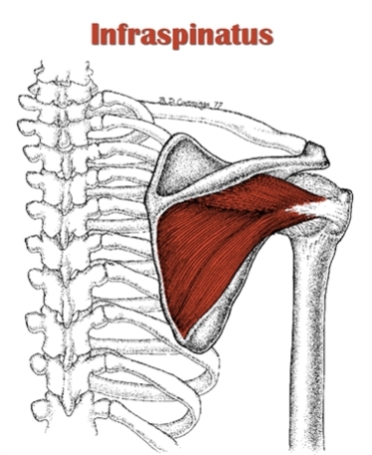
This post will take a closer look at the infraspinatus, one of your four rotator cuff (RC) muscles. Located just under the boney ridge of your shoulder blade, it is commonly injured, especially in overhead athletes (throwers, climbers, etc).

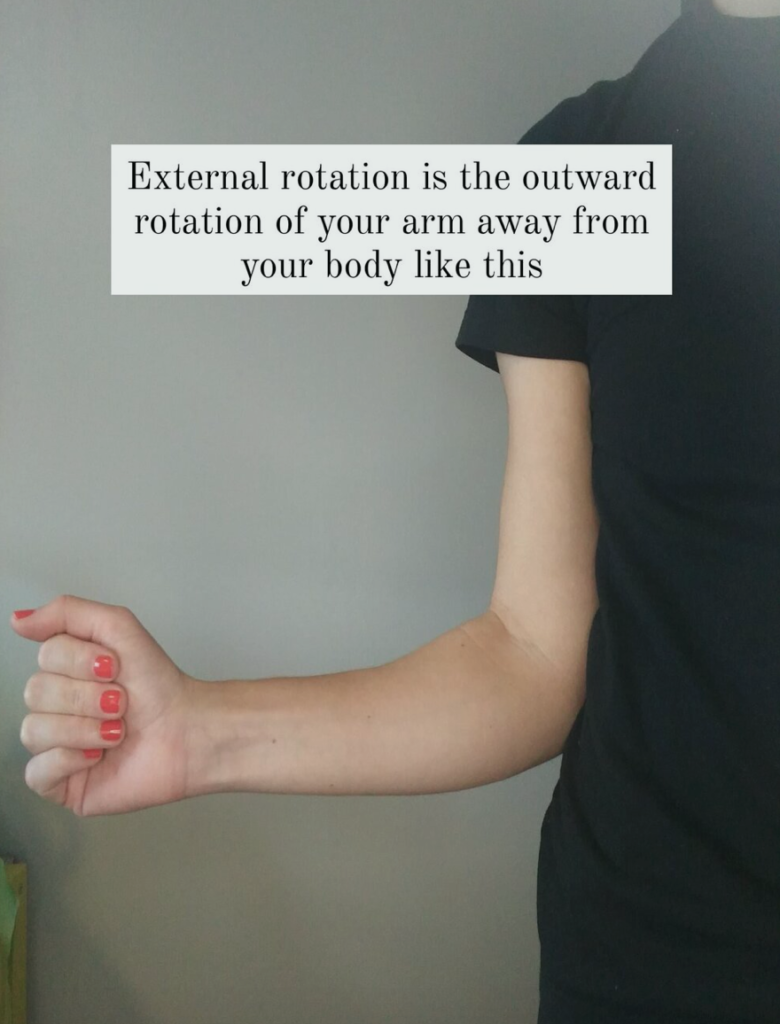
When I learned about the infraspinatus, we were told that it was a muscle that externally rotates, or turns your arm outward (see below for a picture showing that position) and that it is controlled by your suprascapular nerve. But within the last 20 years or so, researchers have found that the infraspinatus has three distinct regions, each innervated by its own mini branch of the suprascapular nerve; the superior, middle, and inferior infraspinatus subregions.

Why does this matter? Well, turns out that the subdivisions serve slightly different purposes, kind of like how your municipality functions within the province. The province of Ontario has an overarching goals, but Waterloo Region will function in a different way than say the GTA. They also will take on more or less burden depending on the task at hand (regional containment of COVID19 being a prime and timely example). This goes for the subregions too – some sections might turn on more or less depending on the degree of arm elevation, your plane of movement, and resistance.


If that’s the case, then is there a way to make rehab more specific by targeting movements that bias one subregion over another?

I was hoping the answer would be yes, but the research isn’t there yet. It seems as though there are still some discrepancies in the research about which subregion does what. Furthermore, the role of the inferior infraspinatus has yet to be determined.

I have summed up 4 key takeaways below in terms of the roles of the subregions:

  1. All three subregions of infraspinatus are more active the higher your arm is in front of you (eg: they will work harder if you are reaching into a high cupboard, and will work less if reaching for something at waist height).
  2. The superior infraspinatus has a shared insertion on the top of the arm bone with your supraspinatus (another RC muscle that will have its own blog post next). It is thought that both muscles contribute to shoulder stabilization, and that redundancy allows for people to have tears and still be strong.
  3. The middle infraspinatus is more of a pure external rotator.
  4. There is minimal evidence for the role of the inferior infraspinatus.

What does this mean for rehab?

  • When you are dealing with a fresh injury, start with exercises where your arm is low and closer to your body, like farmer’s carries. Any load on your arms will turn on your rotator cuff, and this is the least provoking position to be in.
  • You can start with isometrics (exercises where you are not moving your arm through range) if you cannot even move the shoulder without pain.
  • You don’t have to rotate your shoulder to get your infraspinatus. You can just do an arm raise and it will work all three subregions. The higher your arm, the more the infraspinatus will be working.
  • Generally, strengthening external rotation follows the same principle. The movement of rotating your arm outward will be more challenging the further away your upper arm is from your body (overhead vs tucked into your side).

Check out the video below for 4 different exercises that target the infraspinatus, ranging from lower muscle activation to the most, using the principles I outlined above. Some of these exercises are based on articles published by researchers at the Digital Industrial Ergonomics and Shoulder Evaluation Laboratory at the University of Waterloo (local shout out!).

The next write up will target the supraspinatus – yet another notorious RC muscle that also has 2 subregions despite being super slender. As I eluded to above, superior infraspinatus shares an insertion with supraspinatus, and we will talk about why that is so important for shoulder stability and how you could approach rehabilitation for a torn supraspinatus. Stay tuned!

Sayaka is an evidence based physiotherapist in Waterloo. Click here

to learn more about her!

How long until we officially race again?  I would say probably at least a few weeks, wouldn’t you?  While I’m sure many of you miss toeing the line, there are some positives.  For instance, one of the best ways to take advantage of this extended offseason is to work on weaknesses that are normally tough to address.

Constantly acting in A-race mode, followed by tapering, followed by recovering can definitely result in short term spikes in performance. But often the long term, gradual development is sacrificed.

A great way to take a swing at improving your baseline ability to perform is a full strength program. However, it is not as logical to include when in close proximity to an A-race.  If you’re anything like me, you’ve thought of introducing more strength work throughout the pandemic.  If you’re not like me, you’ve actually done it- good for you, you jerk!

The questions that I get from the team on this topic are endless.  I have written about the topic in short before such as here.  However, I thought it was finally time to take a deep dive into strength training for endurance athletes.

CLICK HERE to read the rest in the Run Waterloo Magazine. 

Book your appointment

Contact us to book your next appointment

Call Us 519 885 4930