Today we’re looking at a systematic review that looked at strength training and its impact on adolescent idiopathic scoliosis- you can check out the full text HERE.
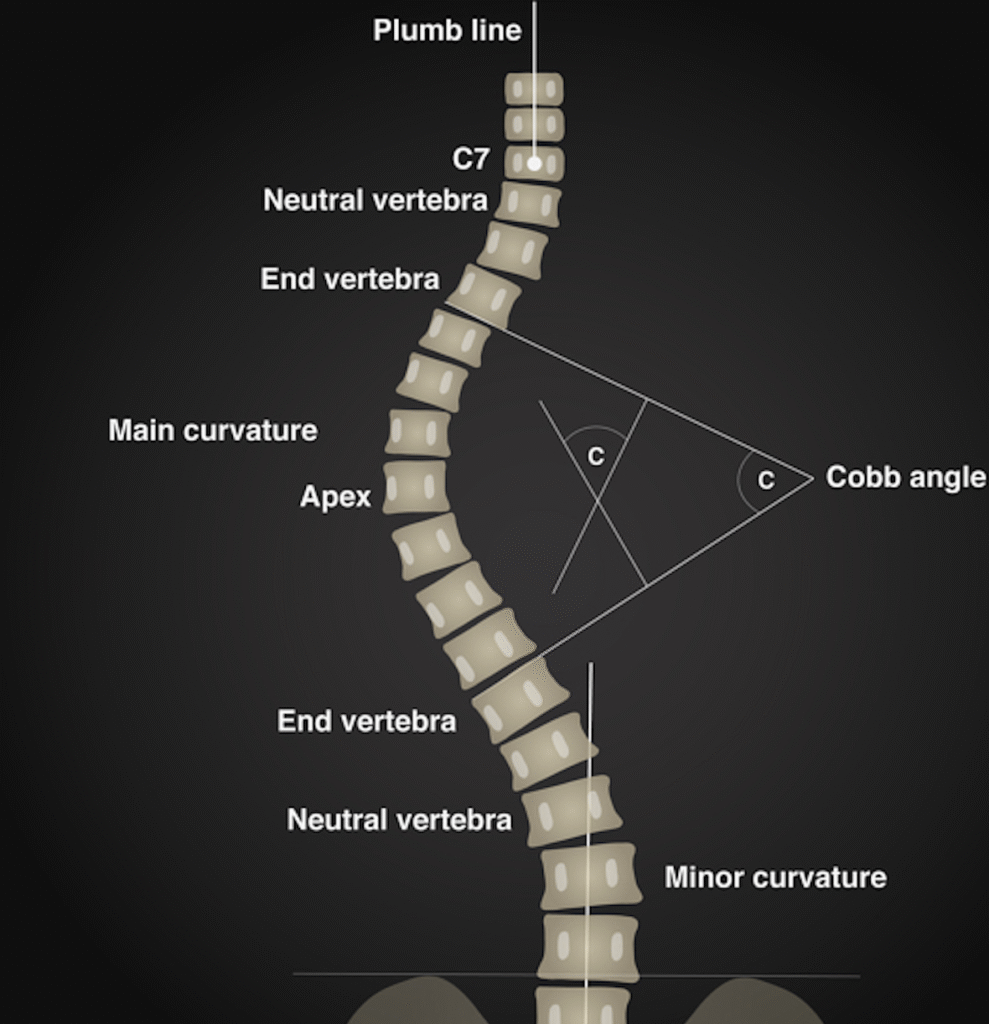
AIS is the form of scoliosis that develops in otherwise healthy teenagers for no obvious reason and is thought to have a genetic component, although no single genetic cause has been identified. It differs from scoliosis caused by congenital spine malformations, neuromuscular disorders, or age-related degeneration (we re not talking about these with this study). Scoliosis is defined as a lateral spinal curvature of 10° or more on Cobb angle measurement with vertebral rotation- and the vast majority of cases are AIS (80%)!
Sudy:
The authors analyzed data from 10 randomized controlled trials involving 449 adolescents (average age ~13.3 years, average baseline Cobb angle ~22.9°). Interventions ranged from 8 weeks to 6 months and compared strength training programs to no training or other exercise regimens.
Results
Compared with no intervention, strength training produced:
- A mean reduction in Cobb angle of about 4.37° and improvements in trunk rotation (–1.07°) and vertebral rotation (–0.44°).
- In quality of life as measured by the SRS‑22 questionnaire, mean scores improved by about 0.22 points.
When compared against exercise programs specifically designed for scoliosis correction, such as three-dimensional and Schroth-type exercises, strength training was less effective: the scoliosis-specific programs produced greater improvements in Cobb angle by about 3.95°, trunk rotation by about 1.69°, and aesthetic scores by about 0.89.
These findings indicate that while strength training has measurable benefits beyond inactivity, more targeted scoliosis-specific programs may achieve larger changes.
Practical applications
If you have AIS, do strength work! The data suggest strength training can moderately reduce curvature and improve patient-reported outcomes compared to no intervention, but it may not be as effective as specialized corrective exercise programs.
Surgery and risk of progression
I always get asked about surgery, when and if it is needed. Surgical intervention for AIS is generally considered when curves exceed approximately 45°–50° Cobb angle, especially if progression is likely or rapid while the patient is still growing. If you’re not close to this angle, you should be actively monitored as you grow, but you are not at risk for needing the surgery!
After skeletal maturity, when growth plates close and height velocity ceases, the risk of curve progression decreases substantially. Sometimes larger curves (>30°–40°) may still progress slowly into adulthood, but the main group we are concerned with are those who are still growing! If you have a relatively small angle and you are full grown, your risk of progression is extremely low (but you should still do strength work)!
Conclusion
Strength training can be beneficial for adolescents with mild to moderate AIS in reducing curve magnitude and improving quality of life compared to inactivity- you can’t go wrong with strengthening your spine!
If you have questions, feel free to contact with us to book online HERE.
Comments are closed here.